Chivalry Is Dead
And we must finally let it die

So as we are continuing our discussion of Aristocracy, I want to first acknowledge that the term inevitably causes strong reactions in the people that hear it. One of the reasons for this strong reaction is that “aristocracy” is the great evil that the French Revolution (which is still the North Star of modern leftist morality) was rebelling against.
One of the core statements of liberalism (the 6th Statement in case anyone is interested) according to James Burnham’s Suicide of the West is “A popular revolt against tyranny or dictatorship is right and deserves approval.” Whenever someone points out the categorical insanity of the NeoCons most recent decision to bomb a country into oblivion based on this tired trope, the examples of tyranny that get trotted out in support are inevitably drawn from the behavior of the French aristocracy in the last 10 minutes before the French Revolution. A more sophisticated interlocutor might cite the more recent and relevant example in the bad behavior of the Spanish Nobility in the run-up to the Spanish civil war. But in either case, they present the same image, a decadent, privileged, nobility, unwilling to work, and useless on the modern battlefield, who use their wealth and power, inherited without effort from prior generations.
But this begs the question that I ended the last article with: How does a class of nobility, which was insanely dominant for almost a thousand years and produced unrelenting success over and over again, become so weak and ridiculous in such a short time? How do you go from El Cid to Don Quixote? From leading thousands of men and inspiring all of Europe, to being a figure of ridicule tilting at windmills? The answer cannot simply be moral decay; something more structural must have shifted beneath them.
I believe the answer lies in the death of Chivalry, which I would argue is at LEAST as relevant as the “Death of God” and likely moreso. To be clear the ACTUAL death of God would be wildly more important than the death of Chivalry but as the enemies of Christ seem to forget with hilarious regularity, rumors of the death of the Crucified God are ALWAYS overstated. He (and his Church) just keep coming back. Chivalry however, IS truly dead, and I maintain that it is NOT EVER coming back.
So when I say Chivalry is not coming back.. what precisely to do I mean?
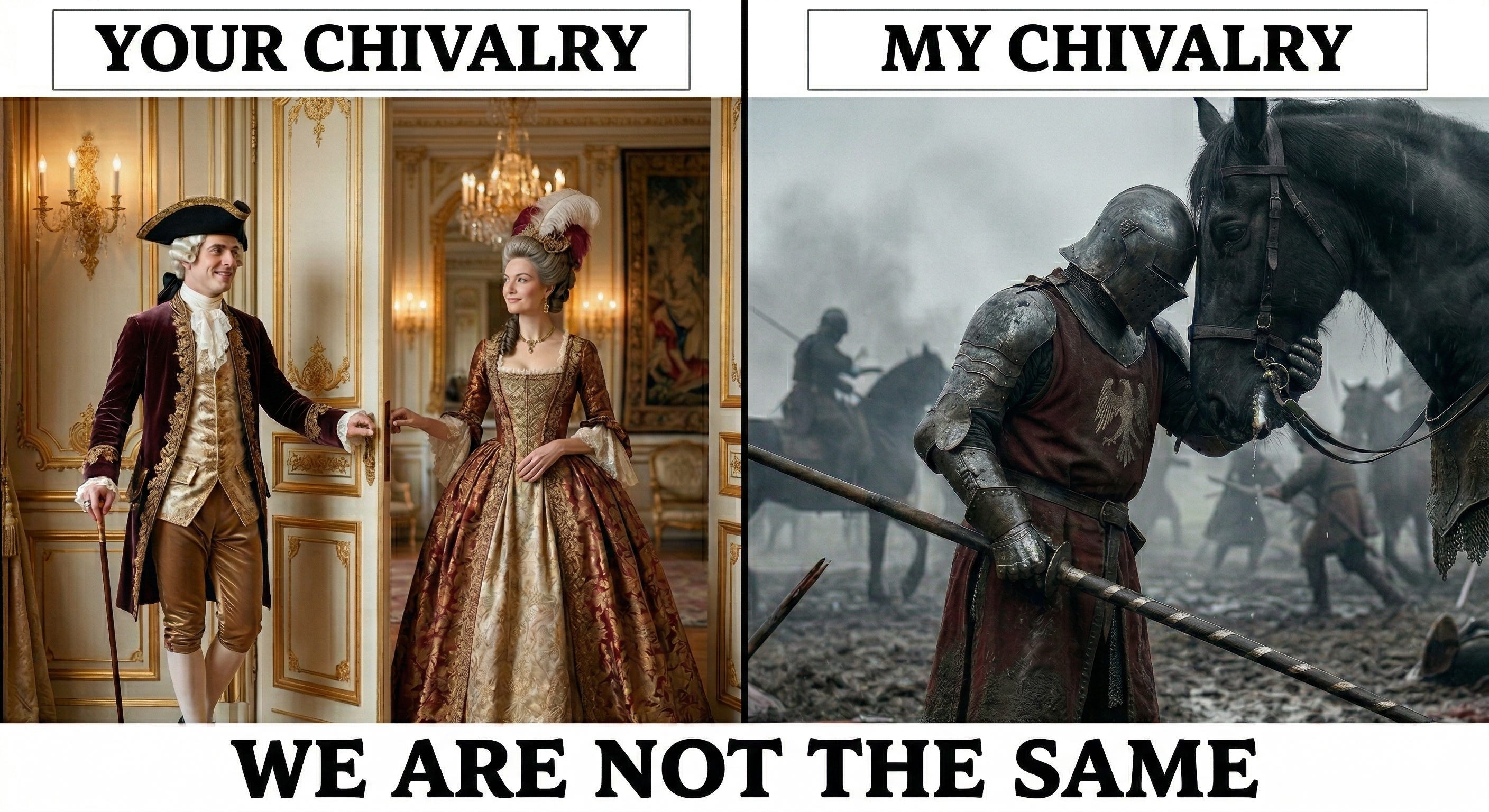
As the meme goes… we are not the same.
What chivalry IS is the depersonalized form of the French noun chevalier, which is to say a Cavalryman, which is to say a HORSEMAN. For those of you who are grammatical nerds, Grok tells me that the French -erie suffix involves shifting from the Subject of the Horseman, to the Object of Horsemanship. So chivalry IS in its essence, the set of qualities that made you excellent at the business of efficiently killing other men from the back of the horse.
There is a great paradox here, in that the first qualification for the utter brutality of medieval combat is to build a relationship of trust (often quite an emotional relationship) with a skittish, violent, powerful horse.
There is a scene that you have likely seen in various horse-related movies, it is the story of a boy becoming a man. At some point, the man has been stripped of everything, his name, his identity, (sometimes his clothes). And a horse, a WILD horse, enters the scene. Then the music swells and the man slowly, slowly (so as not to startle the filly) walks up, places his hand on the horse’s cheek, blows into her nostrils, and slowly slowly looks her in the eyes. And of course, the horse dips her head and blows her breath back to him, and all of a sudden he is able to leap upon her back and they ride off into the sunset.
I have actually seen an experienced horse trainer go through “the moment” with a horse. Of course with most horses, and most people, and in most times there is a great deal more preparation and lead-up to “the moment” at which a horse decides that there is a man worth riding her. But having been witness to those moments, there is a kernel of truth to the movie portrayal, in that it is much more like a switch flipping, a moment of magic, pure and beautiful in which the internal character of the man taming the horse is particularly evident. That is of course the highest example of a whole range of skills in which a man proves himself worthy to ride an already trained horse, which is particularly important when the horse is a destrier, trained to fight and kill almost as efficiently as his master.
In the 5th century BC Herodotus tells us the Persian way of raising men: “Teach him the horse, and the bow, and teach him to despise all lies.” From the moment that Herodotus writes that line and for the next 2000 years (from say 500 BC until 1500 AD), the horsemanship, the Chivalry of a man, and his nation was a critical indicator of their ability to be successful in battle. Cavalrymen are distinguished from infantrymen by many things but perhaps most significant is that infantry might be skilled in defense, but were notoriously bad at pursuit. Cavalrymen were the dominant piece of a victorious army’s ability to continue in pursuit of a defeated enemy, which is what allowed a victory to turn into loot, properties, and the acclaim of their countrymen and countrywomen.
As I said last week, what people miss is that originally chivalry was not a social affectation or even a leadership training mechanism, but an actual path to wealth and power.
Now this leads to an interesting question, riffing on the domain mastery concept I articulated some weeks back. If Chivalry is (or was originally) the mastery of the skillset of a cavalryman, the paradox of taming a horse then the next question is what are “similar” domains that the master Cavalryman can easily adapt to with a “high efficiency ratio.” And what you find is a VAST amount of western linguistic metaphors making comparisons between women and horses. From Tolstoy’s Anna Karenina, or Shakespeare’s Venus and Adonis, all the way down to the constant quest in the Manosphere to find a “Ride or Die Woman.”
The Ride or Die woman comes to us most directly from the motorcycle culture (whose enduring strength I believe draws from its ability to give new life to a culture optimized for the horse). But before it was a motorcycle culture reference it was a horseman reference.
Allow me to set the scene: you have a medieval battlefield and local women have gathered to cheer on the victors. The Leader of the victors, covered in blood (mostly others), and sweat, rides over to the crowd of peasants, and he slows his horse. Various women meet his eyes, and in classic female fashion look away and then look back. He selects one and he and his horse walk toward her slowly, slowly so as not to spook the (human) filly in front of him. And then all at once she reaches up and he reaches out and swings her on the back of his saddle, and rides off with her into the sunset. They likely do not know each other’s names and she may not even speak his language… but such relationships were romanticized across Europe for most of the medieval period and the legend continues today.
From a domain mastery perspective, modern science tells us about the hormone Oxytocin, which at least in mammals, is associated with concepts like trust and honor. If you are unsure, in the slightest degree about the truth of your words, and your ability to keep the promise, explicit or implied, your body WILL not produce oxytocin or not very much of it. As far as we can tell (and modern science’s ability to understand pheromones is painfully limited), men, women, horses, and likely all mammals close enough to catch your scent will KNOW down in their bones whether your words line up with your scent, whether you are worthy for them to take the intimate, vulnerable step of “pledging their troth” and placing their lives and futures in your hand.
It is the paradox of war that in order to be a good leader, you must LOVE your men, and in order to be a good leader you must take your men whom you love into battle to fight and die, often on behalf of a higher noble whose love for you is what qualifies him to send you into battle to fight and perhaps to die.
So in this context, Chivalry was a skillset that involved building trust with a VERY powerful animal, which granted you a literally superhuman level of strength to direct on the field of battle. The domain mastery of that field ALSO proved very “near” to other domains such as inspiring love and loyalty from women, that men found useful and fulfilling in their lives.
So moving beyond mere Chivalry, I would frame the archetype of medieval European nobility as the overlap of 6 “technologies” or domains that an aristocrat or noble was expected to be master of. Three domains involved animal husbandry (again note the overlap between domains implied in that phrase), specifically the Horse, Hound, and Hawk. The other three domains were weapons technologies, specifically the Sword, Bow, and (mounted) Lance. While time does not permit me to go through each of these domains and list out the specific personality traits and the “related” or “nearby” domains, I assure you that various combinations of these specific technologies function almost as a fingerprint. Throughout European history as there were subtle shifts in the technology used by different groups, it produced QUITE a diversity of flavors of “Aristocracy.” For example, you would NEVER confuse an Italian or Spanish aristocrat with a German or an English noble.
But there were some commonalities produced among other things, a high value on not working with your hands, on cultivating a “gentlemanly mindset” on things that were largely incompatible with the new firearm technology (though the Musketeers tried quite hard). What would later become known as the “Protestant work ethic” is likely a result of the personality traits that made men more likely to survive the conflicts using early firearms, most notably the 30 years war.
Earlier I mentioned Don Quixote, the ridiculous figure tilting at windmills. In college I had a macro-economics professor who was OBSESSED with Don Quixote. He claimed that all of the problems that Don Quixote was trying to solve were the result of the cheap mechanical labor introduced by the industrial revolution. This cheap mechanical labor was crashing the old peasant labor markets, the children of the peasants were leaving to find better jobs, and many nobles were faced with the ignominious choice of suing the peasants into leaving their serfdom or going bankrupt under the strain of feeding so many mouths whose labor no longer paid for their keep. The main vector by which this industrialization was entering the countryside were these new Windmills, whose mechanical power could be applied to an almost ENDLESS number of jobs that used to require abundant peasant labor. And so as my professor was fond of saying, from a macro-economics perspective… the Windmills REALLY WERE Giants eating the peasants’ children.
Now imagine that you are a hereditary noble, an expert in the 6 domains I mentioned above. You might be very very smart, maybe smart enough to intuit on some level that the presence of the Windmills is causing problems that place your ancient vows in peril of being broken. But the distance between the macro-economics problem that you face and the domains in which you are a DEMONSTRATED master: horse, hound, hawk, sword, bow and lance, is IMMENSE. What analogy can you find between the tools that you can bring to bear, and the problem which you utterly lack the vocabulary to describe? Seen in that light, perhaps calling the windmills giants is not so bad. But whether it is bad or not, IT IS THE ANALOGY THAT CHIVALRY DEMANDS. A world in which that analogy does not work, is a world in which… Chivalry is dead, and we have killed it. Which is of course exactly where we are.
The New Aristocracy
Returning to the theme of Domain Mastery, it is important to understand that optimization for a particular thing is not neutral vis-a-vis psychological profiles or genetic types. There is in particular a key barrier to domain mastery that involves the ability to “do the rep.” If the rep is holding a lance and riding on a horse in a joust, then only an exceptionally fit and physically skilled individual can even DO the rep. If the rep requires multiplying four digit numbers in your head as a prerequisite for some more abstract mathematical skill, most of us will never be able to get there.
If an absolute requirement for being successful when being born into a family of a certain class is being able to lift the lance, then not too many generations down, you have eliminated virtually all of those who lacked the necessary capacity.
As I hope to discuss in more depth in my next article, for the past 400 years, there has not been anything like that kind of selection pressure for the bulk of society, at least not in any objective sense. There have certainly been domains (particularly banking, law, certain types of mass media) that maintained a kind of skill-based aristocracy, but nothing with the kind of eugenic power the of the constant cavalry-based contests that marked every European generation between Charlemagne and Cromwell. In the main, aristocracy became a thing that was inherited, or could be bought if one accumulated sufficient wealth in a domain totally removed from the Sword, Bow, and Lance and as I discussed last week the Battle-Ax.
We are unfamiliar with the idea of a functional aristocracy, an aristocracy who are all experts in a core technology or set of technologies, and who can evaluate each other in skill-based duels using those technologies or depend on each other in a war in which they are the measure, the champions of their nations. In an important sense, for the past 400 years, since the invention of the firearm in some ways there has not been any true aristocrats, no true knights who won their spurs in battle. All of our elites have been some variation of plutocrats or inherited oligarchs. Wealth begets wealth in a system that rarely, if ever, makes contact with reality.
But I am writing this because perhaps a new aristocracy is rising. Perhaps people achieving domain mastery in complex, skill-based fields like Software Engineering, Cryptography and of course overshadowing all the rest AI. Perhaps the title of Technoking will become more than a joke made in a public filing.
I am quite serious about this. I think it is entirely possible that in 50 years time, battles will be conducted by drones and counter drones, rockets and counter rockets, managed at inhuman speeds by bespoke AI servants. It is possible, and even seems likely (given the preeminent success of Palantir) that specific partnerships between particular men and specially trained AI will rise to prominence. Perhaps we will even be able to test such men by pitting their AI creations against one another in digital tournament of some kind, and evaluate the character the virtu of the man by the AI that he trained and managed, as our ancestors once evaluated a knight’s character by his horse and hawk.
However, we must be careful not to stretch the metaphor too much. The qualities and persona of a man who grows up taming horses and training his hands to draw a bow, is going to be quite different from the man who builds machines from a young age, or has a gift with the deep and abstract programming languages that are now arising in the AI space. The fear of a vampiric horse culture, of aristocrats aping a tradition that made sense when the state of the art transportation technology was a four legged animal being granted undeserved political power once more will not arise.
We will in time find new metaphors to understand the men that are coming to the fore. But Chivalry is dead… and we have clung to its cut off blooms for far too long, they have withered, molded, and finally rotted away. And perhaps that was in the providence of God, that the new aristocrats that may emerge from this burgeoning technology shift will in the large part be truly independent of the old.
As we think about what this technology shift could look like it is useful to think about what the LAST technology shift looked like. I want to illustrated this by thinking about three broad classes of people. In the medieval system you had the martial class with its core skills of chivalry moving from squire to knight, the intellectual class with the development of scribes and scholars, and the artisan class with apprentices and master craftsmen, such as weavers and smiths. Then in a very short time frame, sociologically speaking, knights were replaced by units of infantry man armed with firearms, scribes were replaced with printing presses, and weavers were replaced with textile mills. I would argue that it is THAT technological shift, and the social and economic consequences that flowed from it that created the modern world, and modern liberal democracies.
But we will talk more about that in the next post.
"whether your words line up with your scent, whether you are worthy for them to take the intimate, vulnerable step of “pledging their troth” and placing their lives and futures in your hand."
I think investigating this can lead us to understand how loyalty and honor are assessed. There is very little of this occuring, but we want to build relationships and environments in which this can be constructed. We have more portability now because we can prove honor more reliably with all the tracking data (I think social scores, initiated by the people, will make a big comeback) to know you keep your word. Things like prediction markets, smart contracts and reputation in high status communities will matter.
There must still be a physical component as well.
Tame the motorcycle first. Then, the ladies come