Why do we Purity Spiral?
Choosing between books and walls is a fool's game.

I. Books or Walls?
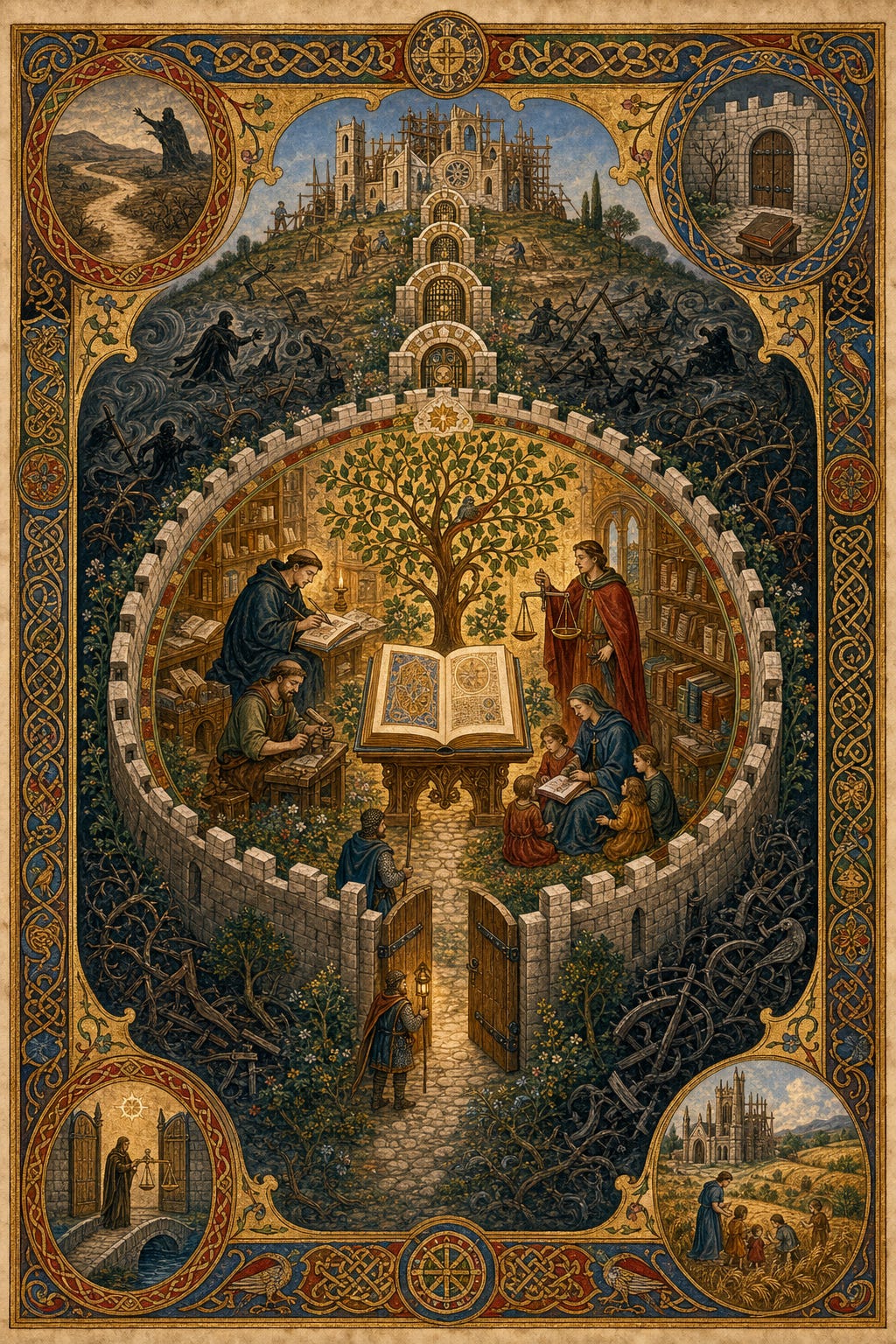
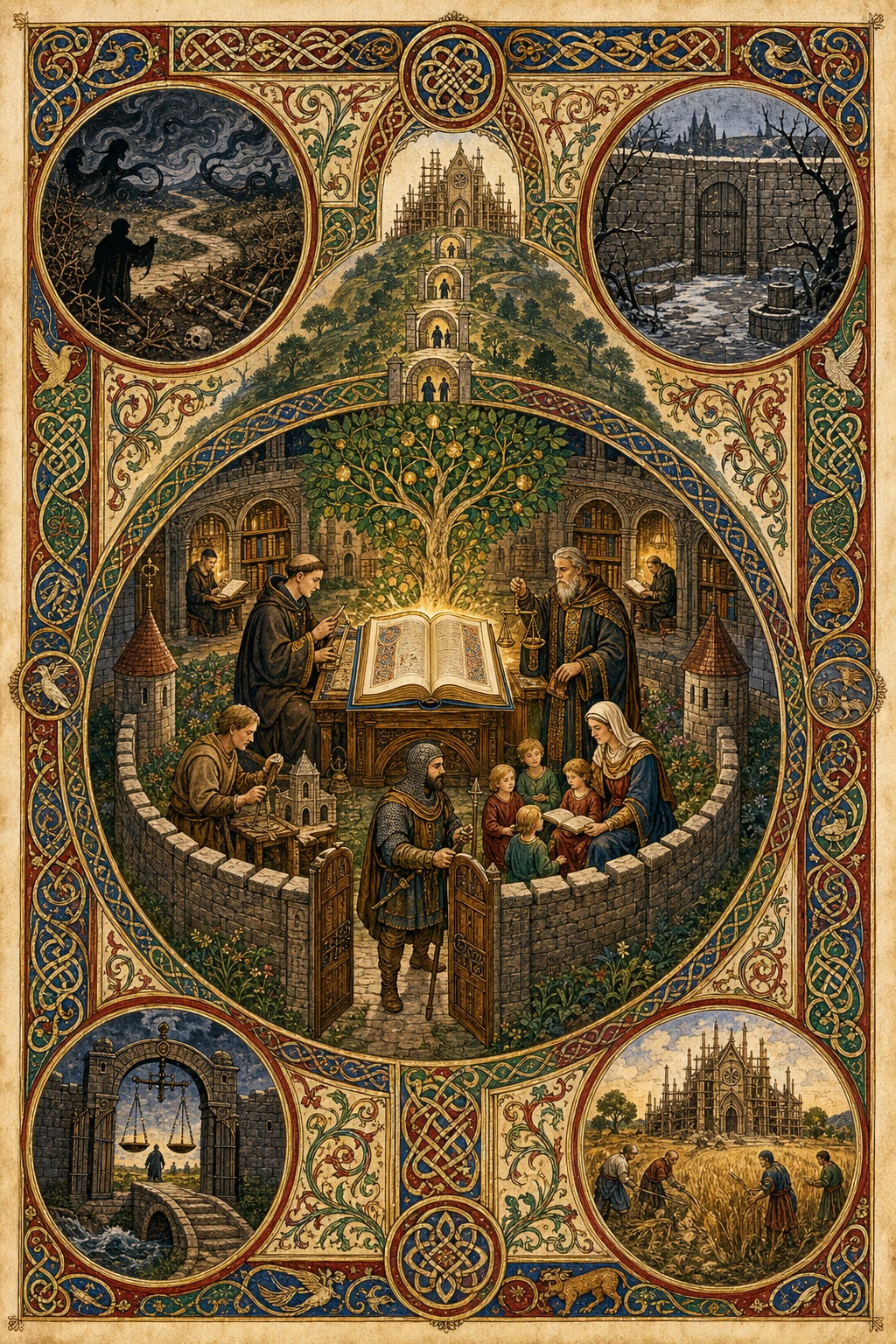
I am the father of several small children, and one of their favorite movies is The Secret of Kells. Its hero is a boy named Brendan, a young novice at the Abbey of Kells, orphaned as an infant in a Viking raid that killed his parents. He is raised by his uncle, the Abbot Cellach, who spends his days furiously building a wall around everything that he has left.
The inciting incident is the arrival of Brother Aidan, a refugee from Iona, carrying an unfinished illuminated manuscript that will one day be called the Book of Kells. Brendan is set to work on the manuscript and falls in love with its beauty. Aidan, in classic center-left fashion, teaches the boy that the book is the thing that can finally defeat the evils the Abbot is walling out. So Brendan is pulled between the two men raising him, the uncle who builds the wall and the old monk who illuminates the book. The film, again in classic center-left fashion, closes with a miracle that vindicates Aidan and indicts Cellach.
Being a student of history, I tell my children about the rough men who eventually secured the British Isles against the Vikings, and I make sure they know the walls were necessary. I also make sure they know the Abbot was wrong. The imbalance the film portrays so well is the one I watch play out over and over in online right-wing purity spirals. Walls are necessary and Cellach was right to build his. His failure was forgetting what the wall was for.
II. “Trust but Verify” is a Left-Wing Frame
This essay continues a conversation Max Meursault began in “The Game Theory of Social Trust,” and The Creative Kingmaker carried forward in “How to Become Trustworthy.” My contribution begins with an observation: the decision to extend (or not to extend) trust is based on two judgments about the world that a man makes often long before the specific decision is in view.
The first is his estimate of human nature at its floor: what share of people, given the opportunity and some reasonable expectation of getting away with it, will lie, cheat, or prey on whoever trusts them. The second is his read of the particular people in front of him, and how far they have already been sorted and curated above that floor.
The left and many libertarians set that floor fairly high. People are basically good, they assume, so any betrayal must be the fault of the one with resources, which the left blithely calls power. If a man proves untrustworthy, something terrible must have been done to him; someone with power must have ruined him, or some deep wound must explain him. You can watch the assumption operate in the left-wing habit of being genuinely shocked to learn that someone they already know and like is a conservative. Their starting point is high. People can be disqualified, can fall, can go down the hill, but the presumption runs toward trust until something knocks it down.
The right starts from an older and harder assumption. In their view, the floor of human behavior is extremely low, and this assumption is validated when you interact with the general adult public, as most right-wingers do, after their parents and the schools have had eighteen to twenty-five years to work on them. IQ is scarce. Virtue is scarcer. Skill at iterated games is scarcest of all, to the point where when you meet someone who has such things you ask which wise and unusual parent or mentor is the reason for this strange unicorn appearing in your world. A rational response to that distribution, of IQ, virtue, and relational skill, is to wall out much of the world. This is the case (and it is a good and reasonable one) for the right-wing instincts about borders, boundaries, and the right to exclude.
But it must be emphasized that there is a danger waiting on this side too, a sin of despair. It says your only move is to wall out the bad, that you can neither grow good people nor go and find more of them. No successful culture in history believed that, and it is the achievements of successful cultures that built the world we live in and want to hand down to our posterity.
The antidote to purity spiraling is to recognize that systems calibrated fairly and run honestly can sort people, and this is easy to verify. Families, and the right kind of business entities, can form and promote from within. Unless you believe God scatters insight and virtue at random among a few souls who can never meet or coordinate, one or both of these strategies can produce almost any combination of traits you can rigorously define. I am asking the right to do nothing more than take its own claims about the heritability of IQ and the formation of character seriously.
In online chat-rooms where this sort of thing takes place, the rejoinder to an observation of the type above is that it is the first and favorite tool of liberalism to forbid us to exclude, to discriminate, to draw the very distinctions that sorting requires. Even if we grant the legal claim for the sake of argument (though conceding the field to the lawfare pirates is neither moral nor actually necessary), there is still a solution that will be obvious once I point it out.
I am referring to the tiered structure the managerial world already runs on. If you can build a series of boxes, tests, and roles, each one supported from deeper in the structure, each one performing a small piece of real work and a large piece of trust-verification or character-illumination, then the whole can judge a player through the narrow part of the game he is currently being allowed to touch. This type of corporate group structure is all over our world, because it is the preferred and necessary legal and organizational structure to have any kind of standards or quality control at all.
The point I am driving at is this. The purpose behind building walls, barriers, and obstacles is to verify, to sort, to find the parties with whom cooperation is finally rational. The low-trust skepticism is a means and never an end. A man who checks and checks and never extends has let his fear govern him and is not serving either himself or the heritage that he claims to treasure.
I will assume my audience already grasps why the leftist strategy (trust and never verify) is a civilizational failure mode. Extending trust is only rational where there is some basis for believing cooperation will be repaid, and that basis is the local ratio of honest players to predators. Meursault’s game-theoretic model is one that I am finding increasingly useful for getting conversations on this topic started. He models a population as three competing strategies. A Believer trusts by default and spends nothing on checking. A Skeptic verifies first and pays for it in time and suspicion. A Liar lives off the Believers, and in a trusting town his con spreads like fire through dry grass, because in the model, every door he knocks on opens. Meursault works out where the mix settles, and in the undifferentiated mass of an open society (which, for our sins, we currently live in) he puts it near seventy Believers and twenty Skeptics for every ten Liars, with that verifying fifth dragging the whole community down to something close to half the output it could reach if no one had to check. Meursault’s analysis is valuable, and necessary to have in the back of your mind in the world built by globalism after the “end of history,” which increasingly resembles a series of glass rooms which anyone can enter and exit at will.
By “the end of history” I do not mean only Fukuyama’s geopolitics. One of the terminal features of globalism is its hostility to iteration, the conviction that personal histories ought to be wiped clean, that past sins should never be held against the sinner and past deeds should never earn anyone a lasting claim. Note of course that one conspicuous exception is the left-wing academic chasing tenure.
I have described Managerial Financialism, the dominant economic framework of our day, as the belief that the value of frictionlessly trading ever more abstract representations of real goods and services will always exceed the cost of the gap between the abstraction and the reality. On the whole the belief holds. The benefit of the arbitrage of frictionless abstractions does outperform the friction it ignores, except of course for the one week in every seven to ten years when the system crashes.
Managerial socialism, the social principle of that same managerial order, is the matching belief that the value of letting a man hit a reset button, shed his debts, and re-enter the market as a null actor will always exceed the cost of leaving his future productivity tied to his past obligations. I have just described the business model of most private equity firms. Both halves of managerialism run on one shared denial, that the accumulated history between people, the very stuff trust is made of, can be abstracted away at no cost.
All of this has an old name. Aristotle taught that courage is the mean between cowardice and rashness, and Nelson Hultberg, in The Golden Mean (Hultberg), sharpened the point that matters here: the mean is not a halfway house between two poles but a third and positive thing, with a vice standing on either side of it. The man who trusts everyone has fallen off the rash side of that virtue, and the open society is rashness written into law. The man who trusts no one has fallen off the timid side and dressed his fear in the language of discipline.
These are both civilizational failure modes, and we must reassert Aristotle’s old understanding of what makes things work. The left-wing extends cooperation it never verifies (even after the most heinous of bad behavior). The other verifies endlessly, without ever extending the trust necessary to actually build things. In the final analysis you need some degree of trust, in God if in nothing else, to sow seeds and wait for a harvest.
III. The PhD and the Day Laborer
The first thing we need to trust in is the capacity of people to be sorted, and that moral agents are indeed capable of sort. Let’s think about two very different sorts of men. Hire a day laborer from a parking lot at six in the morning and you know nothing about the man in front of you. The pool is unsorted. He may be a master craftsman, a thief, a drunk, or among the more reliable workers you might employ, and nothing you can see tells you which. The rational play is low-trust: pay by the day, count your tools, watch the work, assume nothing. That is an honest answer to high variance and zero information, and it carries no contempt for the man.
The doctoral student in a serious (read STEM) program is (or historically was) the opposite case. By the time someone sits in that seminar, they have passed through hundreds, possibly thousands, of sequential filters. Grades across twelve years of school. Standardized tests. Recommendation letters. Admissions committees. Major requirements. Faculty endorsements. A qualifying exam. Every one of those gates is imperfect, and many are noisy or biased, but that is not the point. Assuming that the tiered sorting mechanisms have roughly the same ethical framework, and by the end of it you get someone who is very far down the tail of the bell-curve of the morality that the mechanism was designed to select for.
So high trust is a privilege manufactured by sorting, and it lasts exactly as long as the sorting that made it is honestly enforced. Rome built the cursus honorum on this understanding, a ladder that tested a man at each rung before granting him the next, so that the trust shared among the men at the top was the compounded output of every filter beneath them.
The reason I bring this up is that sorting works. If you ask people what matters to them they will tell you. If you ask them to do symbolic actions, their eagerness or disgust will accurately inform you of their predilections and biases. While there are exceptions (some percentage of the population is genuinely sociopathic), those do not rise to the top unless you have multiple sequential gates with sorting requirements that represent opposite and competing moralities, and a culture would have to be unbelievably stupid to allow that to happen (oh wait...).
IV. What Happens When You Stop Believing in Sorting
The modern right (with good reason) overwhelmingly believes the gates themselves have been captured. This is fine as it is an accurate representation of reality. But the modern right also increasingly believes that gates are inherently left-wing, that sorting “does not work” and that it is not possible to build games that will reliably identify the bad actors in order that they might be removed. They even sometimes begin to believe that the only purpose of gates and sorting rooms is to concentrate the repugnant qualities of their enemies. This leads to a poisonous hermeneutic of suspicion.
I watch the pattern repeat across the contemporary right. Having assembled a screened, vetted, like-minded community, the members go on treating one another as suspects. They reach for rigid hierarchy where trust would serve them better. They re-verify what the sorting already verified. They keep one hand on the weapon in a room where each man present has passed the same test. Edward Banfield, who spent nine months in a dirt-poor village in the south of Italy and wrote it up in *The Moral Basis of a Backward Society* (1958), found the same reflex in low-trust places, where even the weak preferred a hard, hierarchical order because unchecked local predation was the main alternative they had ever known. He recorded the price of it too. Where many families assumed the next family would cheat them, no one cooperated outside the nuclear family, so the roads, the firms, the credit, and the common projects that build wealth never began, and the village stayed poor for generations for no reason but the missing trust. That is the wall-builder’s end state scaled to a society. When the high-trust players are gone and no one will move first, the prosperity the wall was raised to protect is often not created at all.
V. What Causes the Breakdown
Why does this happen? Part of the answer is temperament. The disposition that builds and guards a wall is vigilance. The man who is good at constructing a closed system is, by selection, a high-verifier, a Skeptic in Meursault’s sense, with detection machinery that never turns off. That machinery is what wall-building and wall-guarding demand, and it is the very thing high-trust play forbids. To ask the watchman to extend unguarded trust inside the gate is to ask him to abandon the disposition that built the gate. A man who spent years learning to see threats keeps seeing them after the fence goes up.
Another part is structural, a coordination problem. High trust is a multiplayer equilibrium. Believer play is a successful strategy only when enough others are playing it too. The first man to lower his guard in a room that has not yet committed to trust is the one who gets fleeced. A space full of vigilant people holds very few reliable trusters to reciprocate an opening move, so no one makes the opening move. Everyone waits for proof of safety that can only arrive after someone has already gone first. You see this in right-wing donor conversations, where small and great alike chatter about the bad experiences they have had, usually in incredibly thin relational contexts. A gate and sorting mechanism can remove predators. It cannot manufacture the simultaneous, voluntary lowering of guard that a high-trust game actually requires. That has to be chosen, and a community selected for never choosing it stays locked in a low-trust stasis long after the danger has passed.
VI. The Meta-Skill of Trust
A competent player (and we should aspire to be competent players) lives between the two failures. He does not extend trust everywhere, because much of the world is an unsorted parking lot and the open-society fantasy gets people robbed. He does not withhold it everywhere, because a life spent verifying inside spaces that already earned trust runs at half output, and a walled house that no one inside it will trust is just an expensive prison. The skill is to read the local ratio, build or seek the gates that change it, and then, once the sorting has done its work, find the nerve to play the game the gates made possible.
That last move is the one both wings miss, in opposite directions. The left wants the harvest of a high-trust society without tending the field that grows it. The right tends the field with great discipline and then will not sit down to eat. Knowing which game you are in is half the meta-skill. Being willing to actually play it, once you know, is the half almost no one practices, and it is worth more than either reflex alone.
VII. The End of the Dark Ages
Which brings me back to Kells, and to the conversation that I have with my children every time they watch it. The danger that Cellach was guarding against was very real, and unfortunately, simple faith in books led to tragedy again and again.
We call that succession of tragedies the Dark Ages, and the name is not just propaganda. It was a dark time. The West had not yet learned how to build walls that worked: not merely piles of stone around an abbey, but law, jurisdiction, and the will to enforce them. Vikings came from the north and burned what they could reach. Later, Muslim armies came from the south and did the same. Monasteries that should have been libraries became charnel houses. Men paid blood price for murder and called it peace. For centuries the Church opposed capital punishment, “peace and charity” sat atop the legal order, and even serious crimes were settled in private concords that looked like mercy and functioned like impunity. The wicked were not punished. The good did not live in peace.
The lack of justice was not limited to violent crimes. There was also a gross amount of immorality. Around 1051 Peter Damian sent Pope Leo IX the Liber Gomorrhianus, a treatise against the sexual corruption of the clergy. Damian did not write about abstract decadence. He wrote about priests and monks in active sin, including the abuse of boys entrusted to their care, and about superiors who knew and would not act. The men at the top preached forgiveness while predators kept their offices. Northern Christians built what defenses they could and still got raided, paid compensation, and (at the behest of cruel and corrupt priests) forgave again and again.
But if you know anything about what comes next in the history of the West, you know we solved it. That is the part they do not want you to study when they tell you the Middle Ages were nothing but filth and superstition. In the eleventh century Church and State reached the consensus that the wicked should be punished so the good may live in peace. As Peter Frost and Henry C. Harpending document in “Western Europe, State Formation, and Genetic Pacification”: for nearly seven centuries they Christendom went on to execute its criminals at a rate of roughly one to two percent every generation.
The Thomistic reform turned institutional rot from something to massage into something to purge. Clerical discipline became load-bearing again. Law acquired teeth. And then, over the centuries that followed, the West learned how to combine what the men of Kells could not: walls in service of the book, not instead of it. Castles that made farmland legible and defensible. Cathedrals that turned stone into catechism. Early universities that turned education into a ladder those with sufficient IQ could climb in principle. Libraries and scriptoria that mastered new techniques for copying and preserving texts until they finally were able to spread their core canon to a shockingly large amount of outputs across Christendom. High medieval Christendom was not perfect. It was not gentle by modern lights. But it was, for the first time a Christianity which took seriously the need to protect that which God had entrusted to it. A monastery became what it was always meant to be: a library with walls around it, and in many beautiful ways, Europe as a whole became such a library.
The harvest of that synthesis is the proof that the outcomes we fear are not inevitable. Europe did not stumble out of the Dark Ages by accident. It climbed out because men recognized that we need both books and walls, and the transformation that books create works best in a stable calm walled garden. We learned that worked stone, built by men who were transformed by the Book, could build those magnificent structures that come down to us today as cathedrals.
In Conclusion, we all know now that the open society will not work (though many of us should have known much earlier). But we have to retain hope that we can seize control of various gates and rooms, that each one that we and others like us control matters, that each contributes to our ability to build rooms in which we can once again engage in high-trust activities. I teach my children that if they stay within the rooms that I build, and guard, and purify by my life and work, if they keep the inheritance that I am building for them, then one day they will build cathedrals. And I encourage all of you to do the same.
rything that he has left.
The inciting incident is the arrival of Brother Aidan, a refugee from Iona, carrying an unfinished illuminated manuscript that will one day be called the Book of Kells. Brendan is set to work on the manuscript and falls in love with its beauty. Aidan, in classic center-left fashion, teaches the boy that the book is the thing that can finally defeat the evils the Abbot is walling out. So Brendan is pulled between the two men raising him, the uncle who builds the wall and the old monk who illuminates the book. The film, again in classic center-left fashion, closes with a miracle that vindicates Aidan and indicts Cellach.
Being a student of history, I tell my children about the rough men who eventually secured the British Isles against the Vikings, and I make sure they know the walls were necessary. I also make sure they know the Abbot was wrong. The imbalance the film portrays so well is the one I watch play out over and over in online right-wing purity spirals. Walls are necessary and Cellach was right to build his. His failure was forgetting what the wall was for.
II. “Trust but Verify” is a Left-Wing Frame
This essay continues a conversation Max Meursault began in “The Game Theory of Social Trust,” and The Creative Kingmaker carried forward in “How to Become Trustworthy.” My contribution begins with an observation: the decision to extend (or not to extend) trust is based on two judgments about the world that a man makes often long before the specific decision is in view.
The first is his estimate of human nature at its floor: what share of people, given the opportunity and some reasonable expectation of getting away with it, will lie, cheat, or prey on whoever trusts them. The second is his read of the particular people in front of him, and how far they have already been sorted and curated above that floor.
The left and many libertarians set that floor fairly high. People are basically good, they assume, so any betrayal must be the fault of the one with resources, which the left blithely calls power. If a man proves untrustworthy, something terrible must have been done to him; someone with power must have ruined him, or some deep wound must explain him. You can watch the assumption operate in the left-wing habit of being genuinely shocked to learn that someone they already know and like is a conservative. Their starting point is high. People can be disqualified, can fall, can go down the hill, but the presumption runs toward trust until something knocks it down.
The right starts from an older and harder assumption. In their view, the floor of human behavior is extremely low, and this assumption is validated when you interact with the general adult public, as most right-wingers do, after their parents and the schools have had eighteen to twenty-five years to work on them. IQ is scarce. Virtue is scarcer. Skill at iterated games is scarcest of all, to the point where when you meet someone who has such things you ask which wise and unusual parent or mentor is the reason for this strange unicorn appearing in your world. A rational response to that distribution, of IQ, virtue, and relational skill, is to wall out much of the world. This is the case (and it is a good and reasonable one) for the right-wing instincts about borders, boundaries, and the right to exclude.
But it must be emphasized that there is a danger waiting on this side too, a sin of despair. It says your only move is to wall out the bad, that you can neither grow good people nor go and find more of them. No successful culture in history believed that, and it is the achievements of successful cultures that built the world we live in and want to hand down to our posterity.
The antidote to purity spiraling is to recognize that systems calibrated fairly and run honestly can sort people, and this is easy to verify. Families, and the right kind of business entities, can form and promote from within. Unless you believe God scatters insight and virtue at random among a few souls who can never meet or coordinate, one or both of these strategies can produce almost any combination of traits you can rigorously define. I am asking the right to do nothing more than take its own claims about the heritability of IQ and the formation of character seriously.
In online chat-rooms where this sort of thing takes place, the rejoinder to an observation of the type above is that it is the first and favorite tool of liberalism to forbid us to exclude, to discriminate, to draw the very distinctions that sorting requires. Even if we grant the legal claim for the sake of argument (though conceding the field to the lawfare pirates is neither moral nor actually necessary), there is still a solution that will be obvious once I point it out.
I am referring to the tiered structure the managerial world already runs on. If you can build a series of boxes, tests, and roles, each one supported from deeper in the structure, each one performing a small piece of real work and a large piece of trust-verification or character-illumination, then the whole can judge a player through the narrow part of the game he is currently being allowed to touch. This type of corporate group structure is all over our world, because it is the preferred and necessary legal and organizational structure to have any kind of standards or quality control at all.
The point I am driving at is this. The purpose behind building walls, barriers, and obstacles is to verify, to sort, to find the parties with whom cooperation is finally rational. The low-trust skepticism is a means and never an end. A man who checks and checks and never extends has let his fear govern him and is not serving either himself or the heritage that he claims to treasure.
I will assume my audience already grasps why the leftist strategy (trust and never verify) is a civilizational failure mode. Extending trust is only rational where there is some basis for believing cooperation will be repaid, and that basis is the local ratio of honest players to predators. Meursault’s game-theoretic model is one that I am finding increasingly useful for getting conversations on this topic started. He models a population as three competing strategies. A Believer trusts by default and spends nothing on checking. A Skeptic verifies first and pays for it in time and suspicion. A Liar lives off the Believers, and in a trusting town his con spreads like fire through dry grass, because in the model, every door he knocks on opens. Meursault works out where the mix settles, and in the undifferentiated mass of an open society (which, for our sins, we currently live in) he puts it near seventy Believers and twenty Skeptics for every ten Liars, with that verifying fifth dragging the whole community down to something close to half the output it could reach if no one had to check. Meursault’s analysis is valuable, and necessary to have in the back of your mind in the world built by globalism after the “end of history,” which increasingly resembles a series of glass rooms which anyone can enter and exit at will.
By “the end of history” I do not mean only Fukuyama’s geopolitics. One of the terminal features of globalism is its hostility to iteration, the conviction that personal histories ought to be wiped clean, that past sins should never be held against the sinner and past deeds should never earn anyone a lasting claim. Note of course that one conspicuous exception is the left-wing academic chasing tenure.
I have described Managerial Financialism, the dominant economic framework of our day, as the belief that the value of frictionlessly trading ever more abstract representations of real goods and services will always exceed the cost of the gap between the abstraction and the reality. On the whole the belief holds. The benefit of the arbitrage of frictionless abstractions does outperform the friction it ignores, except of course for the one week in every seven to ten years when the system crashes.
Managerial socialism, the social principle of that same managerial order, is the matching belief that the value of letting a man hit a reset button, shed his debts, and re-enter the market as a null actor will always exceed the cost of leaving his future productivity tied to his past obligations. I have just described the business model of most private equity firms. Both halves of managerialism run on one shared denial, that the accumulated history between people, the very stuff trust is made of, can be abstracted away at no cost.
All of this has an old name. Aristotle taught that courage is the mean between cowardice and rashness, and Nelson Hultberg, in The Golden Mean (Hultberg), sharpened the point that matters here: the mean is not a halfway house between two poles but a third and positive thing, with a vice standing on either side of it. The man who trusts everyone has fallen off the rash side of that virtue, and the open society is rashness written into law. The man who trusts no one has fallen off the timid side and dressed his fear in the language of discipline.
These are both civilizational failure modes, and we must reassert Aristotle’s old understanding of what makes things work. The left-wing extends cooperation it never verifies (even after the most heinous of bad behavior). The other verifies endlessly, without ever extending the trust necessary to actually build things. In the final analysis you need some degree of trust, in God if in nothing else, to sow seeds and wait for a harvest.
III. The PhD and the Day Laborer
The first thing we need to trust in is the capacity of people to be sorted, and that moral agents are indeed capable of sort. Let’s think about two very different sorts of men. Hire a day laborer from a parking lot at six in the morning and you know nothing about the man in front of you. The pool is unsorted. He may be a master craftsman, a thief, a drunk, or among the more reliable workers you might employ, and nothing you can see tells you which. The rational play is low-trust: pay by the day, count your tools, watch the work, assume nothing. That is an honest answer to high variance and zero information, and it carries no contempt for the man.
The doctoral student in a serious (read STEM) program is (or historically was) the opposite case. By the time someone sits in that seminar, they have passed through hundreds, possibly thousands, of sequential filters. Grades across twelve years of school. Standardized tests. Recommendation letters. Admissions committees. Major requirements. Faculty endorsements. A qualifying exam. Every one of those gates is imperfect, and many are noisy or biased, but that is not the point. Assuming that the tiered sorting mechanisms have roughly the same ethical framework, and by the end of it you get someone who is very far down the tail of the bell-curve of the morality that the mechanism was designed to select for.
So high trust is a privilege manufactured by sorting, and it lasts exactly as long as the sorting that made it is honestly enforced. Rome built the cursus honorum on this understanding, a ladder that tested a man at each rung before granting him the next, so that the trust shared among the men at the top was the compounded output of every filter beneath them.
The reason I bring this up is that sorting works. If you ask people what matters to them they will tell you. If you ask them to do symbolic actions, their eagerness or disgust will accurately inform you of their predilections and biases. While there are exceptions (some percentage of the population is genuinely sociopathic), those do not rise to the top unless you have multiple sequential gates with sorting requirements that represent opposite and competing moralities, and a culture would have to be unbelievably stupid to allow that to happen (oh wait...).
IV. What Happens When You Stop Believing in Sorting
The modern right (with good reason) overwhelmingly believes the gates themselves have been captured. This is fine as it is an accurate representation of reality. But the modern right also increasingly believes that gates are inherently left-wing, that sorting “does not work” and that it is not possible to build games that will reliably identify the bad actors in order that they might be removed. They even sometimes begin to believe that the only purpose of gates and sorting rooms is to concentrate the repugnant qualities of their enemies. This leads to a poisonous hermeneutic of suspicion.
I watch the pattern repeat across the contemporary right. Having assembled a screened, vetted, like-minded community, the members go on treating one another as suspects. They reach for rigid hierarchy where trust would serve them better. They re-verify what the sorting already verified. They keep one hand on the weapon in a room where each man present has passed the same test. Edward Banfield, who spent nine months in a dirt-poor village in the south of Italy and wrote it up in *The Moral Basis of a Backward Society* (1958), found the same reflex in low-trust places, where even the weak preferred a hard, hierarchical order because unchecked local predation was the main alternative they had ever known. He recorded the price of it too. Where many families assumed the next family would cheat them, no one cooperated outside the nuclear family, so the roads, the firms, the credit, and the common projects that build wealth never began, and the village stayed poor for generations for no reason but the missing trust. That is the wall-builder’s end state scaled to a society. When the high-trust players are gone and no one will move first, the prosperity the wall was raised to protect is often not created at all.
V. What Causes the Breakdown
Why does this happen? Part of the answer is temperament. The disposition that builds and guards a wall is vigilance. The man who is good at constructing a closed system is, by selection, a high-verifier, a Skeptic in Meursault’s sense, with detection machinery that never turns off. That machinery is what wall-building and wall-guarding demand, and it is the very thing high-trust play forbids. To ask the watchman to extend unguarded trust inside the gate is to ask him to abandon the disposition that built the gate. A man who spent years learning to see threats keeps seeing them after the fence goes up.
Another part is structural, a coordination problem. High trust is a multiplayer equilibrium. Believer play is a successful strategy only when enough others are playing it too. The first man to lower his guard in a room that has not yet committed to trust is the one who gets fleeced. A space full of vigilant people holds very few reliable trusters to reciprocate an opening move, so no one makes the opening move. Everyone waits for proof of safety that can only arrive after someone has already gone first. You see this in right-wing donor conversations, where small and great alike chatter about the bad experiences they have had, usually in incredibly thin relational contexts. A gate and sorting mechanism can remove predators. It cannot manufacture the simultaneous, voluntary lowering of guard that a high-trust game actually requires. That has to be chosen, and a community selected for never choosing it stays locked in a low-trust stasis long after the danger has passed.
VI. The Meta-Skill of Trust
A competent player (and we should aspire to be competent players) lives between the two failures. He does not extend trust everywhere, because much of the world is an unsorted parking lot and the open-society fantasy gets people robbed. He does not withhold it everywhere, because a life spent verifying inside spaces that already earned trust runs at half output, and a walled house that no one inside it will trust is just an expensive prison. The skill is to read the local ratio, build or seek the gates that change it, and then, once the sorting has done its work, find the nerve to play the game the gates made possible.
That last move is the one both wings miss, in opposite directions. The left wants the harvest of a high-trust society without tending the field that grows it. The right tends the field with great discipline and then will not sit down to eat. Knowing which game you are in is half the meta-skill. Being willing to actually play it, once you know, is the half almost no one practices, and it is worth more than either reflex alone.
VII. The End of the Dark Ages
Which brings me back to Kells, and to the conversation that I have with my children every time they watch it. The danger that Cellach was guarding against was very real, and unfortunately, simple faith in books led to tragedy again and again.
We call that succession of tragedies the Dark Ages, and the name is not just propaganda. It was a dark time. The West had not yet learned how to build walls that worked: not merely piles of stone around an abbey, but law, jurisdiction, and the will to enforce them. Vikings came from the north and burned what they could reach. Later, Muslim armies came from the south and did the same. Monasteries that should have been libraries became charnel houses. Men paid blood price for murder and called it peace. For centuries the Church opposed capital punishment, “peace and charity” sat atop the legal order, and even serious crimes were settled in private concords that looked like mercy and functioned like impunity. The wicked were not punished. The good did not live in peace.
The lack of justice was not limited to violent crimes. There was also a gross amount of immorality. Around 1051 Peter Damian sent Pope Leo IX the Liber Gomorrhianus, a treatise against the sexual corruption of the clergy. Damian did not write about abstract decadence. He wrote about priests and monks in active sin, including the abuse of boys entrusted to their care, and about superiors who knew and would not act. The men at the top preached forgiveness while predators kept their offices. Northern Christians built what defenses they could and still got raided, paid compensation, and (at the behest of cruel and corrupt priests) forgave again and again.
But if you know anything about what comes next in the history of the West, you know we solved it. That is the part they do not want you to study when they tell you the Middle Ages were nothing but filth and superstition. In the eleventh century Church and State reached the consensus that the wicked should be punished so the good may live in peace. As Peter Frost and Henry C. Harpending document in “Western Europe, State Formation, and Genetic Pacification”: for nearly seven centuries they Christendom went on to execute its criminals at a rate of roughly one to two percent every generation.
The Thomistic reform turned institutional rot from something to massage into something to purge. Clerical discipline became load-bearing again. Law acquired teeth. And then, over the centuries that followed, the West learned how to combine what the men of Kells could not: walls in service of the book, not instead of it. Castles that made farmland legible and defensible. Cathedrals that turned stone into catechism. Early universities that turned education into a ladder those with sufficient IQ could climb in principle. Libraries and scriptoria that mastered new techniques for copying and preserving texts until they finally were able to spread their core canon to a shockingly large amount of outputs across Christendom. High medieval Christendom was not perfect. It was not gentle by modern lights. But it was, for the first time a Christianity which took seriously the need to protect that which God had entrusted to it. A monastery became what it was always meant to be: a library with walls around it, and in many beautiful ways, Europe as a whole became such a library.
The harvest of that synthesis is the proof that the outcomes we fear are not inevitable. Europe did not stumble out of the Dark Ages by accident. It climbed out because men recognized that we need both books and walls, and the transformation that books create works best in a stable calm walled garden. We learned that worked stone, built by men who were transformed by the Book, could build those magnificent structures that come down to us today as cathedrals.
In Conclusion, we all know now that the open society will not work (though many of us should have known much earlier). But we have to retain hope that we can seize control of various gates and rooms, that each one that we and others like us control matters, that each contributes to our ability to build rooms in which we can once again engage in high-trust activities. I teach my children that if they stay within the rooms that I build, and guard, and purify by my life and work, if they keep the inheritance that I am building for them, then one day they will build cathedrals. And I encourage all of you to do the same.